Rankevra Blog
Topical Authority Tool: The 5-Point Checklist That Matters
August 9, 2026
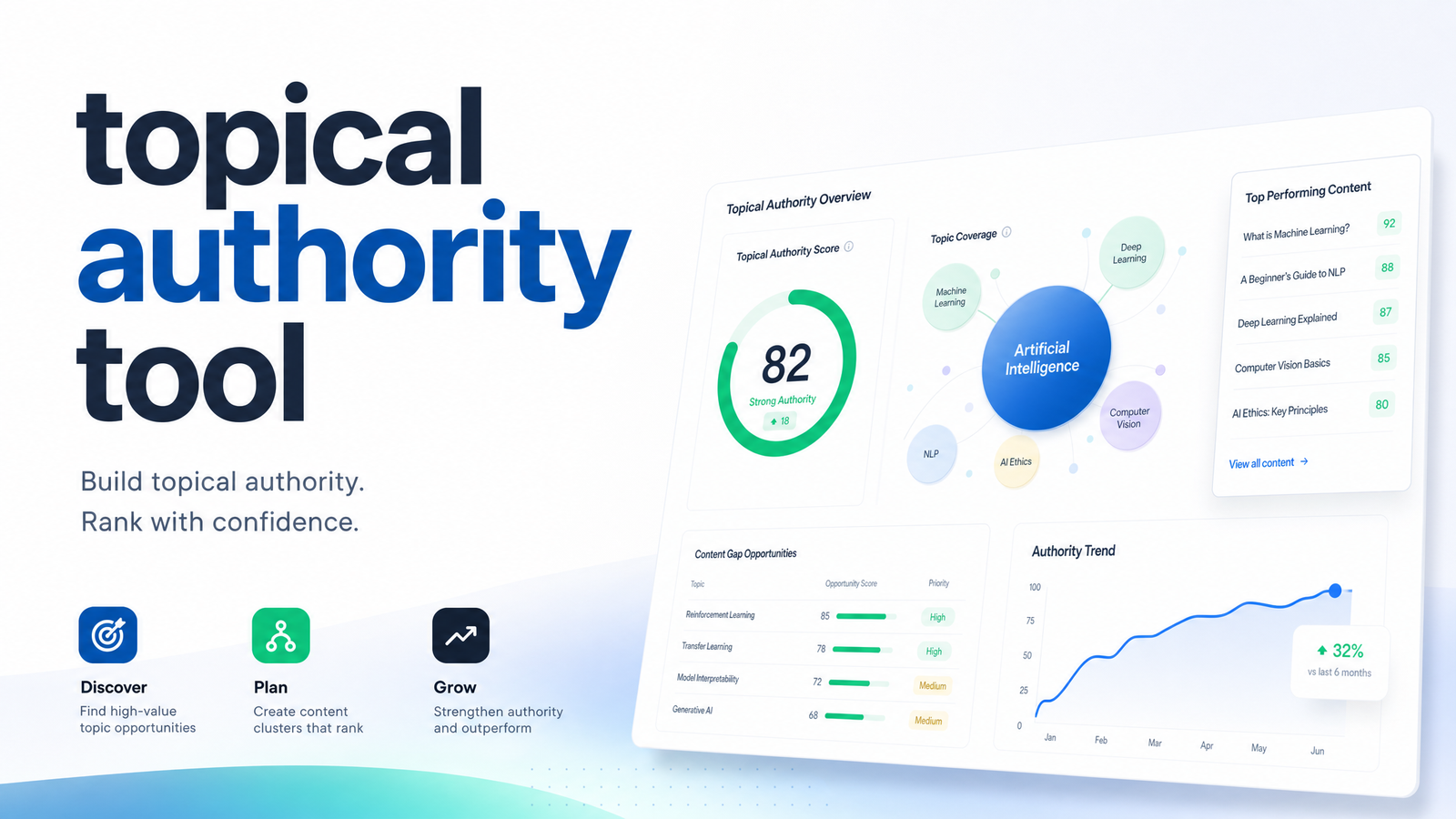
Type "topical authority tool" into a search bar and you'll get a grab-bag of products: keyword clustering apps, content brief generators, AI writers with a topic-map skin bolted on, and technical audit tools that added a "topics" tab last quarter. They all use the same label. Almost none of them do the same job.
The Category Confusion: 'Topical Authority Tool' Means Five Different Things
That's not a marketing accident — it's a category still forming. In its narrowest, most common form, a topical authority tool is really a keyword clustering tool wearing a bigger name: it groups keywords by semantic similarity and hands you a spreadsheet of clusters. A content brief tool takes those clusters and outlines them. An AI writer drafts against the outlines. A rank tracker tells you, weeks later, whether any of it worked. Vendors increasingly market whichever piece they own as "topical authority software," so two products with the same name on the landing page can solve completely different problems.
If you need the conceptual grounding first — what topical authority actually means and why search engines reward it — the real framework behind topical authority SEO is worth reading before you evaluate software. This article assumes you already know the "why" and want the "which tool": a concrete checklist for testing whether a product marketed as a topical authority tool does the whole job, or just the first step of it.
The 5-Point Checklist: What a Real Topical Authority Tool Must Do
A genuine topical authority tool has to do five things, in sequence, without forcing you to hand off to another app between steps.
1. Map topics and subtopics to a pillar structure. This is the step every tool claims. A real topic cluster tool doesn't just list related keywords — it organizes them hierarchically under pillar pages, showing which subtopics support which pillar and where the structure has orphaned branches. If your "map" is a flat list sorted by search volume, it's a clustering output, not a topical map.
2. Detect coverage gaps against competitors and SERPs, not just list keywords. This is where most tools quietly stop being useful. A content gap tool should compare what you've published against what's ranking for a topic cluster and flag the specific subtopics, questions, or entities you're missing — not just surface more keywords you haven't targeted. There's a real difference between "here are 40 keywords" and "here's the subtopic your top three competitors cover that you don't," worth understanding in depth via a full content gap analysis framework.
3. Turn map items into content briefs or drafts automatically. An AI topical authority tool should connect the map directly to production — generating a brief or draft the moment a gap is identified, tied to the search intent and entities that gap requires. If moving from "we found a gap" to "here's a brief a writer can use" requires exporting to a different tool, you've re-introduced the manual bottleneck the software was supposed to remove.
4. Enforce internal linking between pillar and cluster pages. Not suggest it — enforce it, or at minimum flag every missing link the moment new content publishes.
5. Track authority over time, at the topic-cluster level, not just per-keyword rank.
Each of these is a distinct engineering problem. A tool that's genuinely good at all five is rare — which is exactly why the checklist is worth running before you buy.
Where Most 'Topical Authority Tools' Fall Short
The failure pattern shows up almost every time: a tool nails steps one and two — mapping and maybe gap detection — then stops. From there, you're on your own. You export the map, brief the writer in a separate doc tool, publish through the CMS manually, and check rankings in a fourth tool a month later.
This is where topical maps go stale. The map was accurate the day it was built, but nobody updates it as content gets published, so six months in it no longer reflects reality. It's also where internal linking quietly fails — every "topical authority checker" will tell you that pillar-to-cluster linking matters, but almost none of them actually add the link or flag its absence when a new cluster page goes live. Writers forget, editors don't know the map exists, and pillar pages end up isolated from the cluster content meant to reinforce them.
The other common failure is tracking. Plenty of tools for building topical authority will show you a map at the start of a project and a rank tracker dashboard at the end, with nothing connecting the two. When rankings dip, you can't tell if it's a content gap that opened up, a technical issue crawling under the radar, or just noisy tracking — because the tools that would tell you don't talk to each other.
How to Evaluate One Before You Buy
Before you commit budget to any tool claiming to build topical authority, ask the vendor — or test in a demo — for the following. This is a fast, practical topical authority tool evaluation you can run in fifteen minutes:
- "Show me a gap it found that a human missed." Anyone can list unranked keywords. A real content gap tool should surface a subtopic or entity your competitors cover and you don't, something a manual audit would plausibly skip.
- "Show me the internal link it added automatically." Not a recommendation in a report — an actual link inserted, or a real-time alert the moment a cluster page publishes without one.
- "Show me authority tracked over 90 days, not just today's rankings." Ask specifically what metric moves besides individual keyword position — cluster-level visibility, coverage percentage, share of ranking subtopics.
- "What happens when I publish new content — does the map update itself?" If updating the map is a manual re-run, it will fall out of sync with reality within a quarter.
- "Can it go from gap to published page without leaving this tool?" If the answer involves exporting to a brief tool, then a writer tool, then a CMS, you're buying a clustering tool with a bigger price tag.
If a vendor can't answer these clearly, you're looking at one of the best keyword rank trackers or clustering tools on the market — not a topical authority tool.
Why an End-to-End Workflow Beats a Point Solution
Every gap you leave between mapping and execution is a place where topical authority actually breaks down. A cluster gets mapped but never briefed. A brief gets written but never checked against internal linking rules. A page publishes but the rank tracker isn't watching the right keyword set, so a coverage problem looks like a tracking blind spot instead of what it is. Stitching together a clustering tool, a brief generator, an AI writer, and a separate tracker means someone has to manually keep all four in sync — and in most content teams, nobody consistently does.
An AI SEO workflow that handles mapping, gap detection, content generation, publishing, internal linking, and tracking inside one system removes that handoff entirely. The map isn't a static document — it's the thing content is generated against, the thing publishing checks internal links against, and the thing rank tracking reports back to. When a subtopic starts underperforming, you see it as a gap in the map, not a mystery in a disconnected dashboard.
This is the design Rankevra is built around, and it's the direct answer to what a topical authority tool for content teams should actually look like: a system that maps topics to pillars, detects gaps against real competitor coverage, turns those gaps into briefs and drafts automatically, enforces the internal linking between pillar and cluster pages that manual workflows keep skipping, and tracks authority — not just individual rankings — over time. For teams that want the manual, step-by-step version of the mapping process first, the 5-step topical authority map framework is a good place to start; for internal linking specifically as its own evaluated category, see the internal linking tool evaluation framework; and for how tracking should work over 90-day windows, this rank tracker evaluation framework covers the metrics that matter beyond position.
Running a stack of four or five point tools to execute one topical strategy means paying for four subscriptions, maintaining four logins, and manually reconciling data that should already agree with itself. One workflow that maps, writes, publishes, and tracks against that same map removes the reconciliation work entirely — the map is the source of truth end to end. See your own topical map and coverage gaps in minutes: try Rankevra.
Frequently Asked Questions
What's the difference between a topical authority tool and a keyword clustering tool?
A keyword clustering tool groups related keywords into topic sets and stops there. A topical authority tool takes clustering further — mapping clusters to a pillar structure, detecting real coverage gaps against competitors, generating content against those gaps, enforcing internal linking, and tracking authority over time. If a product only produces a spreadsheet of grouped keywords, it's a clustering tool regardless of what it's marketed as.
Can AI tools actually measure topical authority, or just help build it?
AI tools can measure proxies for topical authority — cluster-level visibility, the percentage of subtopics you rank for, and internal linking density between pillar and cluster pages — even though there's no single official "authority score" from search engines. These proxies, tracked over time rather than as a one-time snapshot, are the closest practical measurement available. Tools that only show individual keyword rankings aren't measuring authority at all, just position.
Do I still need a separate content brief tool if my topical authority tool generates content?
No, not if the topical authority tool connects its gap detection directly to brief or draft generation. The point of an end-to-end workflow is removing that handoff — a separate brief tool becomes necessary only when the mapping tool stops at planning and doesn't produce anything a writer or AI can act on directly.
How long does it take to see ranking results after using a topical authority tool?
Meaningful cluster-level movement typically takes longer than individual keyword tracking suggests, often several months, because topical authority builds as coverage and internal linking accumulate rather than from any single published page. Watch coverage percentage and cluster visibility over a 90-day window rather than judging results from week-one rankings.
Is a topical authority tool worth it for a small site with under 50 pages?
Yes, often more so than for large sites, because a small site has less room for wasted publishing effort and benefits disproportionately from a clear map of exactly which subtopics to prioritize. The gap-detection and internal-linking pieces matter just as much at 50 pages as at 500 — arguably more, since every page needs to earn its place in the structure.
How does a topical authority tool fit with existing rank tracking and audit software?
A well-built topical authority tool should either include cluster-level rank tracking natively or integrate cleanly with existing tracking and audit tools so ranking drops can be diagnosed as content gaps versus technical or tracking issues. If the topical map and the rank tracker are disconnected, a coverage problem and a technical crawl issue look identical from the outside — exactly the blind spot an integrated workflow is meant to remove.
Keep reading
- Content Decay SEO: How to Detect It and Fix It for GoodLearn to detect content decay SEO issues early, rule out false positives, and build a refresh pipeline that scales — plus how to automate the whole loop.
- Headless CMS SEO: Fixing the Gaps Generic Tools MissHeadless CMS SEO breaks in three predictable places: rendering, metadata, and sitemaps. Here's the diagnostic framework to find and fix each gap.
- Google Algorithm Update Recovery: A Diagnostic FrameworkA step-by-step google algorithm update recovery framework: confirm the cause, segment the damage, benchmark against winners, and set a real timeline.