Rankevra Blog
SEO Tool Consolidation: The Real Cost-Savings Math
September 21, 2026
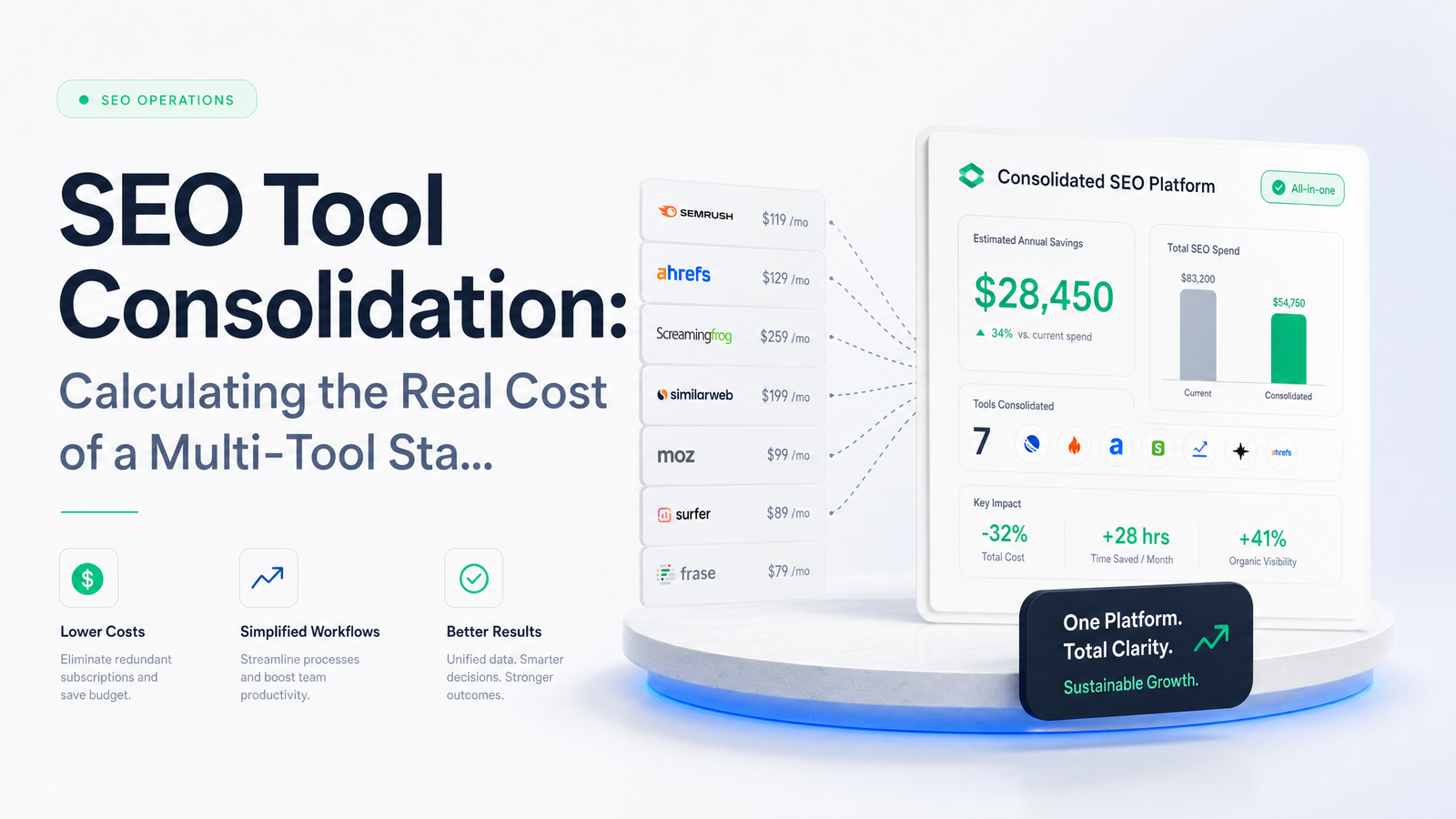
The Multi-Tool Stack Nobody Budgeted For
It usually starts innocently. You pick up a rank tracker for your money keywords. A few months later, a site auditor, because Search Console isn't cutting it. Then a backlink tool to vet link opportunities and watch competitors. Then an AI writer, because content has to scale. Then a reporting dashboard, because nobody wants to build client decks by hand.
Eighteen months in, you're running a full SEO tool stack — five logins, five renewal dates, five support queues — for what is functionally one job: growing organic traffic. Nobody decided this; it accreted, tool by tool, the way most martech stacks do.
Each subscription looks manageable alone. That's the problem: nobody adds up the multi-tool stack as a single line item, so nobody notices five "reasonable" tools have become one unreasonable annual commitment — before counting the time spent stitching their outputs together. This article does that math and shows what SEO tool consolidation actually saves once you account for what a spreadsheet of subscription fees leaves out.
What a Typical SEO Stack Actually Costs (Line by Line)
Here's a realistic five-tool stack, priced at 2026 rates for a small-to-mid SEO team of three to five people.
- Rank tracker: Standalone tracking for a few hundred keywords across a handful of domains typically runs $50–$140/month depending on volume and check frequency. Getting this choice wrong compounds every other cost — see this rank tracker buying guide.
- Site audit tool: Technical crawling and issue detection, often bundled into bigger suites, runs roughly $99–$199/month standalone for mid-size sites.
- Backlink analysis tool: Usually the most expensive line item — $129 to $500+/month depending on tier and seats. See this backlink tool evaluation framework.
- AI content/writer tool: $49–$199/month depending on word credits and users, often billed per seat.
- Reporting dashboard: A dedicated layer pulling data across tools costs another $50–$150/month, more with premium connectors — see this SEO reporting software framework.
Using the mid-points, and the entry/mid-tier pricing for the two most common suite anchors — Ahrefs and Semrush — per this Ahrefs vs Semrush pricing comparison, a team using either as its backlink/audit backbone plus separate best-in-class tools for tracking, content, and reporting typically lands between $450 and $900/month. Add two or three extra seats — SEO is rarely a one-person job — and that climbs another $150–$400/month. Annualized, a mid-size team's realistic SEO software cost lands between $7,200 and $15,600 per year, before a single hour of labor is counted. Teams anchoring on Ahrefs specifically should read this breakdown of what Ahrefs does and doesn't cover before assuming it can absorb the other four tools' jobs too.
That's the visible cost breakdown. It's not the real number.
The Hidden Costs Most Comparisons Ignore
Subscription fees are the easy part of total cost of ownership. The expensive part is everything that happens because the tools don't talk to each other.
Data reconciliation time. Your rank tracker says #4; Search Console says something different; your dashboard aggregates both into a number matching neither. Someone has to compare exports and decide which number goes in the client report — a direct symptom of SEO data silos, and rarely a five-minute job. Teams report losing real, recurring hours weekly just reconciling conflicting data, per this piece on SEO data silos and rank tracking accuracy.
Context-switching. Every tool has its own UI, filters, and definition of "organic traffic." Jumping between five interfaces to answer one question — "why did rankings drop this week?" — costs cognitive overhead that never appears on an invoice but shows up in output per hour.
Onboarding friction. A new hire on a five-tool stack needs five logins, five permission sets, and five mental models before becoming productive. Multiply that ramp-up by every hire and contractor rotation.
Credit and quota overages. AI writers bill by word credits, backlink tools by crawl credits, rank trackers by keyword slots. Stack sprawl means paying for headroom "just in case" across multiple meters, or blowing through limits and eating overage charges.
The utilization gap. The quiet killer. Broader martech research shows organizations often use only a fraction of the capability they pay for — average utilization well under 50%, with teams losing significant weekly time managing stacks of 15-plus tools, per martech stack sprawl and utilization data. SEO stacks aren't immune: that backlink tool's competitor-gap feature you paid extra for is pure sunk cost if nobody uses it. This isn't an isolated pattern — it's structural to how tool stacks grow, per this data on martech stack size and spend.
None of this shows up when comparing list prices. All of it shows up in your actual monthly cost.
Calculating Your Real Total Cost of Ownership
A worksheet you can run in ten minutes with your own numbers.
Step 1 — Sum your subscriptions. Add every tool's monthly fee: rank tracker + site auditor + backlink tool + AI writer + reporting dashboard.
Step 2 — Add seats and add-ons. Include extra user seats, premium data connectors, and any credit top-ups purchased last quarter, averaged monthly.
Step 3 — Estimate reconciliation and context-switching hours. Track one real week: how many hours does someone spend exporting, comparing, or explaining discrepancies between tools? Multiply by fully-loaded hourly rate.
Step 4 — Add onboarding amortization. If hiring or rotating contractors, divide hours needed to get someone fluent across all five tools by 12, and add that monthly fraction.
The formula:
(Sum of subscriptions) + (Seats/add-ons) + (Reconciliation hours × hourly rate) + (Onboarding hours ÷ 12 × hourly rate) = True monthly cost
Run this once, honestly, and most teams find their real number sits 25–40% above what their finance dashboard shows for "software costs." That gap is the case for consolidation — or at minimum, the number needed to make that case to leadership with a straight face.
All-in-One Platform: What Consolidation Actually Buys You
Set an all-in-one SEO platform against that worksheet and the ledger changes shape. One subscription instead of five means one renewal date, one invoice, one point of negotiation. One login means no context-switching between five UIs to answer one question. One unified data model means rank tracking, audit findings, and content performance all reference the same numbers — the Step 3 reconciliation tax drops close to zero because there's nothing left to reconcile.
Rankevra is built around that model. Rather than bundling separate modules that still operate like isolated tools under one bill, Rankevra runs audits, AI content generation, publishing, and rank tracking as one connected workflow — an issue flagged in a technical audit, a content gap identified by the AI writer, and a ranking change tracked over time all live in the same data layer instead of three separate exports.
Against the $7,200–$15,600/year stack total calculated earlier — before adding reconciliation and onboarding hours — a consolidated platform priced as a single subscription doesn't just compete on sticker price. It removes most hidden-cost categories entirely: no cross-tool onboarding, no credit juggling across five meters, no weekly hour spent explaining why two dashboards disagree. For a three-to-five person team, that's often the difference between a stack that pays for itself and one that quietly drains a mid-size marketing budget.
When Consolidation Makes Sense (and When It Doesn't)
Consolidation isn't universal, and treating it as one would undercut this whole exercise. There are real scenarios where specialist point tools still earn their keep.
Consolidation tends to make sense when:
- Your team is small enough that context-switching cost outweighs any single tool's extra depth.
- You're spending more time reconciling data than acting on it.
- Onboarding new hires across multiple logins is a recurring drag.
- Finance is asking hard questions about total software spend and you don't have a clean answer.
It may not make sense when:
- You're an enterprise team doing deep backlink index research at a scale only the largest specialist databases support — link graph size and crawl freshness at that tier is a genuine moat.
- You have highly custom, tool-specific workflows already built around a niche capability no consolidated platform replicates yet.
- Your team is large enough that role specialization (a dedicated technical SEO, a dedicated link builder) outweighs the coordination overhead a single platform removes.
Fast decision checklist: if your worksheet total is dominated by subscription fees with few hidden costs, point tools might still be efficient. If it's dominated by hours lost to reconciliation, onboarding, and context-switching, that's the signal SEO tool stack sprawl — not any single tool — is the actual cost center.
Frequently Asked Questions
How many SEO tools does a typical in-house team actually need?
Most in-house teams run four to six overlapping tools — a rank tracker, site auditor, backlink checker, content/AI writer, and reporting dashboard — even though the underlying job is a single connected workflow. The number grows because tools get added one at a time to solve immediate problems, not because that many separate systems are strictly necessary.
Is it cheaper to buy separate best-in-class tools or one all-in-one SEO platform?
On subscription price alone, a multi-tool stack can look comparable or even cheaper. Once you add seats, credit overages, and hours spent reconciling conflicting data, the multi-tool stack's true total cost of ownership is typically 25–40% higher than its visible invoice total.
What hidden costs do people miss when pricing out an SEO tool stack?
The biggest missed costs are data reconciliation time, context-switching between disconnected interfaces, onboarding new hires across multiple logins, and paying for tool capability that never gets used. None appear on a subscription invoice, but all show up directly in team hours and output.
Will I lose functionality by switching from Ahrefs or Semrush to an all-in-one tool?
You may lose some depth in specialist areas like massive backlink index size or niche competitive research features — a fair trade-off to weigh. For most teams whose core workflow is auditing, tracking, content creation, and reporting, a consolidated platform covers the day-to-day job without that specialist depth being missed.
How do I calculate the true cost of my current SEO tool stack?
Add monthly subscription fees, extra seats and add-ons, and an estimate of weekly reconciliation hours multiplied by hourly rate, then add a monthly share of onboarding time for new hires. That combined figure — not the subscription total alone — is your real total cost of ownership.
What's the difference between tool consolidation and just cutting tools to save money?
Cutting tools removes capability and often just shifts work back onto the team manually. Consolidation replaces the same capability set with one connected platform, so you keep the functionality while removing the reconciliation and context-switching costs that came from those tools not talking to each other.
Run the worksheet above against your own invoices this week — subscriptions, seats, and a real week of reconciliation hours — and you'll have an actual number instead of a guess. Then see what that number looks like against a single platform: Rankevra runs audits, content, publishing, and rank tracking in one workflow, and a trial is the fastest way to compare it to what you're paying now.
Keep reading
- Pagination SEO in 2026: The Post-rel=next/prev PlaybookPagination SEO after rel=next/prev: how to set canonicals, protect crawl budget, fix infinite scroll, and audit paginated series before rankings leak.
- 7 Robots.txt Mistakes That Silently Kill Your RankingsRobots.txt mistakes don't break your site — they just quietly bleed organic traffic. Learn the 7 silent killers and how to audit your file in 15 minutes.
- XML Sitemap Optimization: The 2026 Trust-Signal FrameworkA current guide to XML sitemap optimization: clean URL inclusion, honest lastmod values, splitting strategy, and how to submit without the dead ping endpoint.